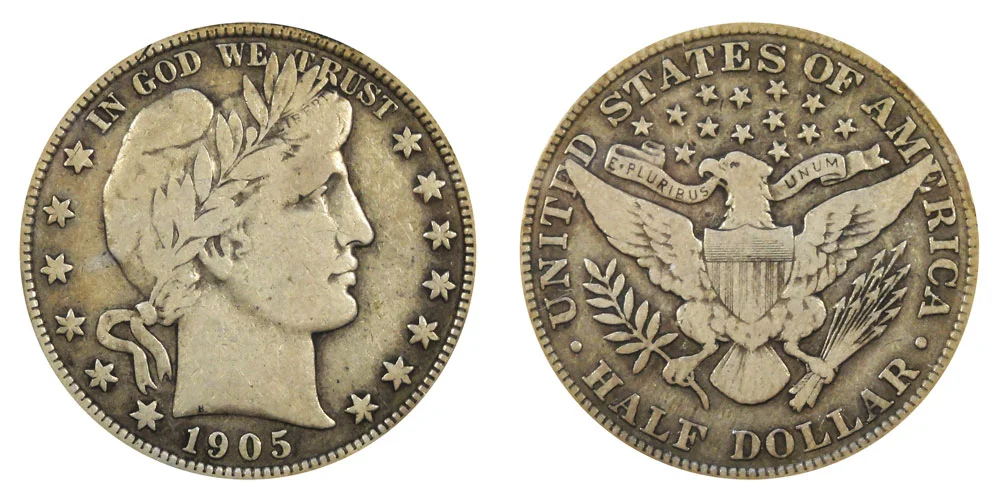
1905 Barber Half Dollar Value
A single 1905 Barber Half Dollar sold for $132,250 at Heritage Auctions — the highest price ever paid for any Barber Half Dollar. While most circulated examples are worth $25–$550, the scarce 1905-O and pristine Mint State survivors can be worth hundreds to thousands. Here's everything you need to know to value yours accurately.
Is Your 1905-O the Valuable Key Date?
The 1905-O (New Orleans) is one of the most sought-after regular-issue dates in the Barber Half Dollar series with just 505,000 struck. Use this checker to confirm whether you have the key date — and not the far more common San Francisco or Philadelphia issue.
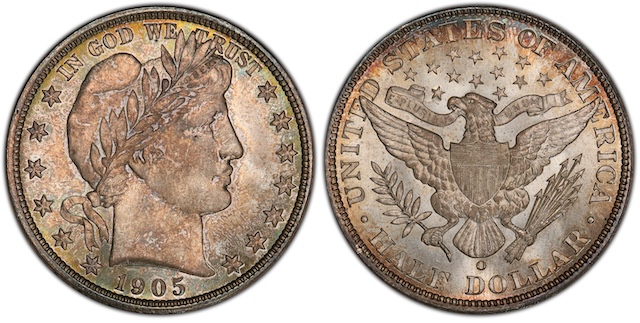
Common — Philadelphia (No Mintmark)
Look above the "D" in DOLLAR on the reverse. If the space is empty (no letter), you have a Philadelphia coin. Mintage was 662,727 — higher than New Orleans. Circulated examples start around $25–$65 in Good condition, rising to $500+ in EF. Still collectible but not the key date.
Key Date — New Orleans (O Mintmark)
If you see a small "O" above the "D" in DOLLAR, you have the key date 1905-O with only 505,000 minted. This is the second-lowest mintage New Orleans Barber Half. Values start at $75–$100 in Good and rise sharply: Fine examples bring $200–$350, and About Uncirculated pieces can fetch $650–$1,200 or more.
Describe Your 1905 Half Dollar for a Detailed Assessment
Tell us what you see on your coin — mint mark, condition, any unusual features — and our analyzer will give you a tailored value estimate.
Mention these things if you can
- Mint mark (O, S, or none)
- How many letters in LIBERTY are visible
- Overall wear level (heavy / moderate / slight / none)
- Any unusual doubling on date or motto
- Whether the coin appears cleaned or toned
Also helpful
- Sharpness of eagle's breast feathers
- Color / toning description (gray, golden, iridescent)
- Any PCGS or NGC certification label
- Strike quality of stars on obverse
- Presence of edge damage or rim nicks
Skipped the Calculator?
If you already know your mint mark and condition, get an instant value estimate in seconds.
Use the Free Value Calculator →Free 1905 Barber Half Dollar Value Calculator
Select your mint mark, condition, and any notable variety below. The calculator maps your inputs to current market value ranges based on PCGS, NGC, and recent auction data.
Step 1 — Select Mint Mark
Step 2 — Select Condition
Step 3 — Notable Features (check all that apply)
If you're not yet sure about your coin's mint mark or condition, the 1905 Barber Half Dollar Coin Value Checker tool is a free third-party resource that can identify your coin and estimate its value from photos alone.
Everything on This Page
Jump to the section you need:
The Valuable 1905 Barber Half Dollar Varieties (Complete Guide)
The 1905 Barber Half Dollar series covers three mints plus proof issues — each with distinct collector premiums. Understanding which variety you hold is the single most important step in determining its value. Below are the four key varieties ranked by collector significance, each with full diagnostic details and current market data.
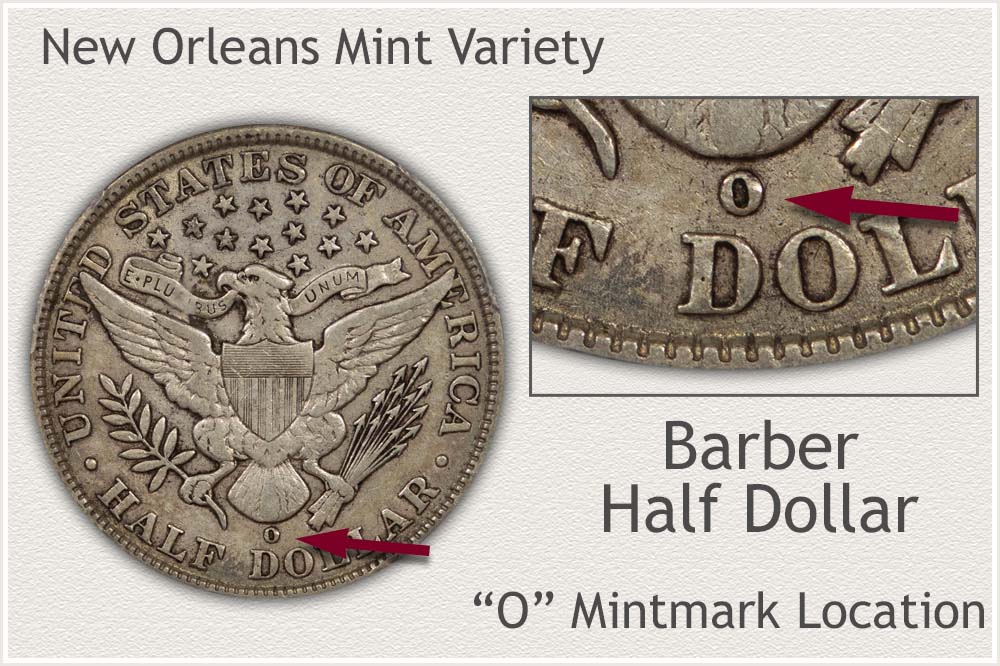
1905-O (New Orleans) $75 – $4,250+
The 1905-O is the most significant regular-issue coin in the 1905 Barber Half Dollar set, with just 505,000 pieces struck at the New Orleans Mint — the second-lowest mintage from that facility across the entire Barber Half Dollar series from 1892 to 1909. Collectors recognize it as a genuine key date, not merely a semi-key, because original high-grade survivors are extraordinarily scarce.
Visually, you identify a 1905-O by locating a small, rounded "O" above the "D" in DOLLAR on the reverse — the mint mark position used throughout the Barber series. The strike quality from New Orleans was variable, and weakly struck examples with soft eagle feathers are common; a fully struck piece commands a meaningful additional premium over a weakly struck counterpart at the same numeric grade.
Collector demand is driven by its key-date status in series completions and dedicated New Orleans collections. Even heavily worn AG-3 to Good-4 examples trade at $45–$75 or more. A PCGS MS-64 1905-O can bring $2,000–$4,500 at major auctions, and MS-65 examples are genuinely rare with population reports in the single digits at top services.
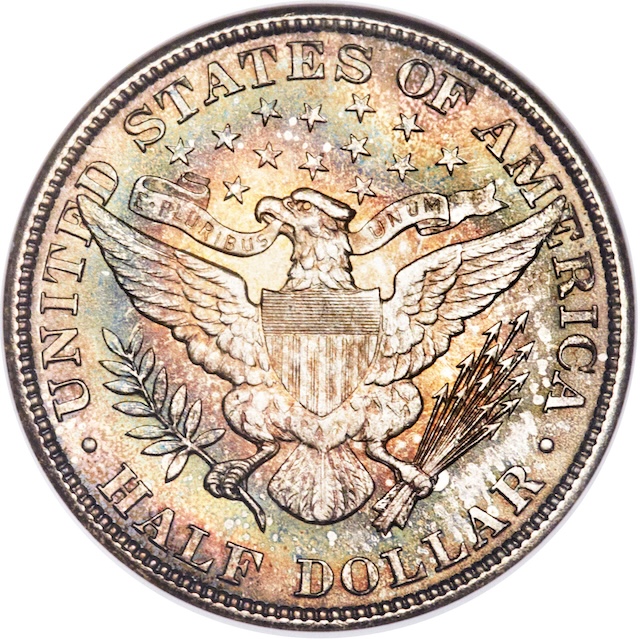
1905-P Philadelphia $25 – $132,250
The Philadelphia issue is the most famous 1905 Barber Half Dollar because it produced the all-time auction record holder — a PCGS MS-68+ example that sold for $132,250 at Heritage Auctions in August 2010, the record price for any Barber Half Dollar of any date. With only 662,727 struck (no mint mark on this issue), Philadelphia's 1905 half stands as the fifth-lowest mintage among all Philadelphia Barber Half Dollars.
Philadelphia coins have no mint mark — the space above the "D" in DOLLAR is blank. The strike quality is generally superior to New Orleans issues, with sharp hair detail and well-defined eagle breast feathers typical on most Philadelphia pieces. However, PCGS population data shows only 27 examples graded MS-65 or finer, making a quality Gem MS-65 genuinely scarce despite the relatively modest price for worn examples.
The deceptive scarcity in Mint State is explained by the coin's working life: 1905 Philadelphia halves circulated heavily as commercial coinage and few escaped use. As noted by numismatic authority David Akers, the 1905-P Philadelphia is comparably rare to many branch-mint keys in high grade, yet collector awareness is lower, creating a potential value opportunity for discerning collectors.
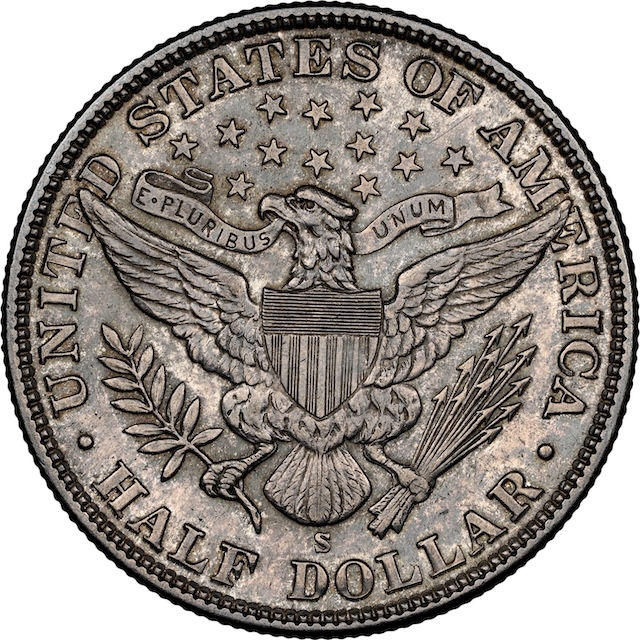
1905-S (San Francisco) $27 – $25,000+
The 1905-S Barber Half Dollar was struck in San Francisco with the highest mintage of the three 1905 issues — 2,494,000 pieces. Despite its relatively abundant production, the 1905-S is far from common in quality Mint State, and top-end certified examples command serious prices. The San Francisco Mint produced the majority of Barber Half Dollars throughout the series, as western commerce consumed large silver coins at a higher rate than eastern commerce.
Identification is straightforward: look for a small "S" above the "D" in DOLLAR on the reverse. San Francisco strikes are generally well-executed with good luster, though some examples show weakness on the right-side border stars — a die characteristic rather than a strike failure. The 1905-S in MS-65 is a beautiful coin with the characteristic satiny San Francisco luster and can show attractive russet-gold toning.
Value climbs steeply from the MS-65 level upward. A 1905-S MS-67 can bring $25,000 or more at auction, and the APMEX listing confirms $25,000 for MS-67 examples. Circulated pieces trade at modest premiums over silver melt, with Good-4 examples at $27–$45 and Fine pieces in the $70–$170 range. The 1905-S is an accessible entry point for Barber Half Dollar series collectors building sets by mint.
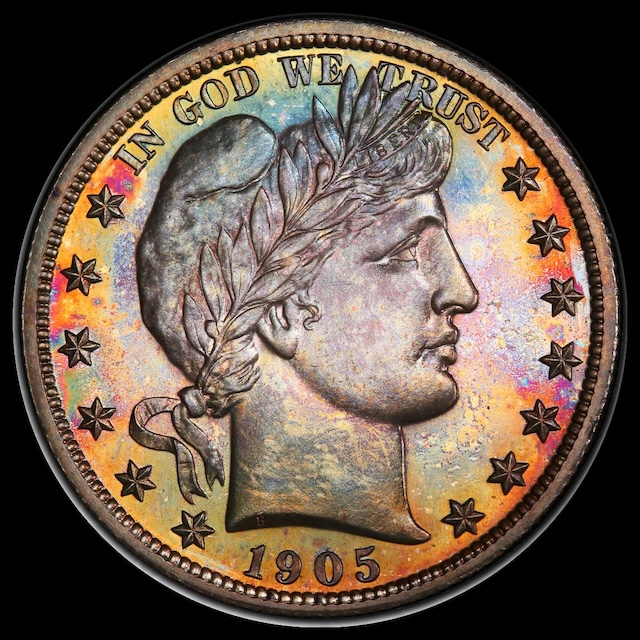
1905 Proof $650 – $35,000+
The 1905 Proof Barber Half Dollar is a deliberately struck collector coin, produced at the Philadelphia Mint using specially prepared dies and planchets to create mirror-like fields and frosted (cameo) devices. With a mintage of just 727 pieces, the 1905 Proof is scarcer by production numbers than either the Philadelphia or New Orleans business strikes, yet it survives in higher average condition because proof coins were handled carefully and preserved by their original owners.
Proof Barber Half Dollars are identified by their deeply reflective fields, sharply squared rims, and fully struck design details — every hair strand and feather is precise and complete. A proof coin held at an angle under light shows a clear mirror reflection in the flat field areas beside Liberty's portrait and in the eagle's background. Cameo contrast (frosted devices against mirror fields) is especially prized and adds a substantial premium.
Interestingly, 1905 proofs are more available in certified high grades than the corresponding Mint State business strikes. PCGS reports 103 examples at PF-65 or finer, while only 27 MS-65 or finer business strikes are certified. A PF-65 trades at $2,000–$2,500. The exceptional PF-68 range brings $24,500–$35,000 per CoinsWorth's 2026 data, reflecting genuine rarity at the finest levels.
Think You've Spotted One of These Varieties?
Use the free calculator above to get an instant value estimate based on your specific mint mark, condition, and any notable features.
Get My Coin's Value Now →1905 Barber Half Dollar Value Chart at a Glance
For an in-depth complete 1905 Barber Half Dollar identification walkthrough and reference, the CoinHix app is an excellent companion. The table below shows current market value ranges for all three mint marks plus the proof issue across four major condition tiers. Values are based on PCGS, NGC, and recent Heritage Auctions data (2025–2026). The 1905-O row is highlighted gold as the key date; the 1905 Proof row is highlighted for its unique collector premium structure.
| Variety | Worn (G–VG) | Circulated (F–EF) | Uncirculated (AU–MS63) | Gem MS (MS64–MS65+) |
|---|---|---|---|---|
| 1905-O (New Orleans) ★ | $75 – $100 | $200 – $720 | $685 – $2,130 | $2,300 – $4,500+ |
| 1905-P (Philadelphia) | $25 – $65 | $115 – $325 | $500 – $750 | $1,350 – $5,250+ |
| 1905-S (San Francisco) | $27 – $45 | $90 – $333 | $496 – $968 | $1,750 – $7,000+ |
| 1905 Proof ★★ | — | — | $550 – $950 | $1,100 – $3,500+ |
★ Key date — premiums above typical market for original uncleaned surfaces. ★★ Proof issue — PF grade scale; values differ from business strike MS grades.
📱 CoinHix lets you scan your Barber Half Dollar from your phone camera and instantly cross-reference its grade against certified population data — a coin identifier and value app.
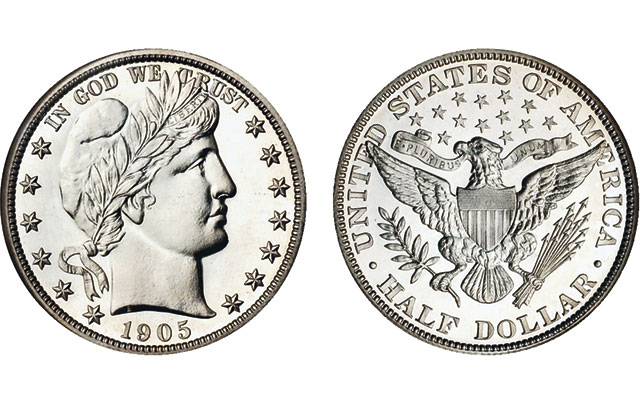
1905 Barber Half Dollar Mintage & Survival Data
Three mints struck Barber Half Dollars in 1905. The combined business-strike total of approximately 3.66 million coins sounds substantial, but survival rates in any condition above Fine are remarkably low — especially for the Philadelphia and New Orleans issues, which circulated heavily in eastern commerce.
| Mint | Mintage | PCGS Pop. (MS) | NGC Pop. (MS) | MS-65 or Finer |
|---|---|---|---|---|
| Philadelphia (P — no mark) | 662,727 | ~103 examples | ~57 examples | ~27 (PCGS) / ~13 (NGC) |
| New Orleans (O) | 505,000 | Limited | Limited | Single digits (PCGS) |
| San Francisco (S) | 2,494,000 | Higher pop. | Higher pop. | Most available of the three |
| Philadelphia Proof | 727 | 304 proofs (PCGS) | ~213 proofs (NGC) | 103 at PF-65+ (PCGS) |
| Total (all issues) | ~3,662,454 | Values based on PCGS/NGC population data per Numismatic News & PCGS CoinFacts (2024–2026) | ||
How to Grade Your 1905 Barber Half Dollar
Barber Half Dollars grade differently from most other U.S. coins because the master hubs were revised in 1901 — post-1900 coins including all 1905 issues wear the LIBERTY headband lettering faster than pre-1901 pieces. Overall wear level is your primary guide; LIBERTY legibility is a supporting check, not the sole determinant.
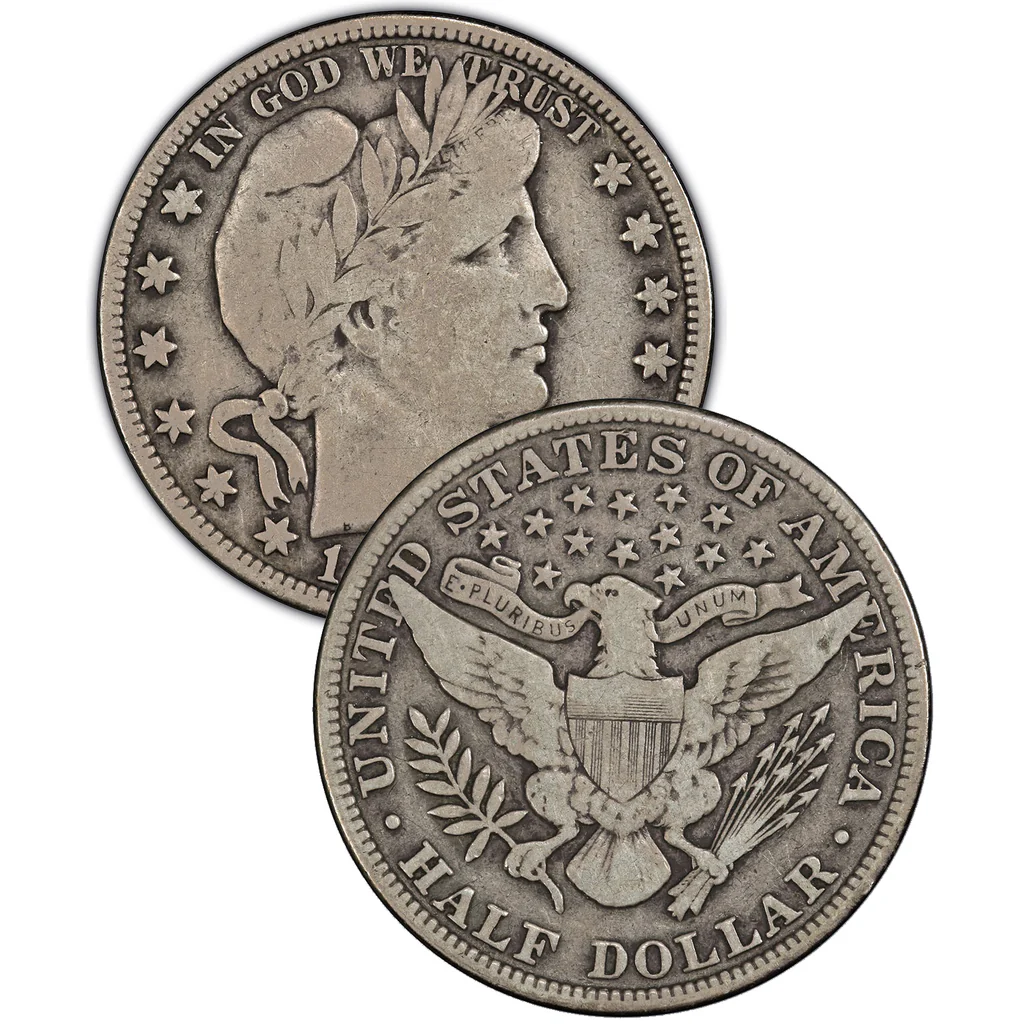
Good to Very Good
LIBERTY on the headband is mostly flat or has only faint traces. The date and major design outline are clear. The portrait, eagle, and legend remain visible but lack fine detail. Values: $25–$100 depending on mint mark. The 1905-O commands the highest premium even in this grade.
Fine to Extremely Fine
In Fine (F-12), most LIBERTY letters are visible but not sharp; moderate even wear across surfaces. In Extremely Fine (EF-40), LIBERTY is full and sharp, wear is light and confined to the highest points — Liberty's cheek and hair above the ear; eagle's breast feathers show most detail. Original luster sometimes survives in protected areas.
About Unc. to MS63
No wear on design high points. About Uncirculated (AU) pieces have full hair detail above the ear and on the eagle's breast, with luster broken only by the slightest friction. MS-60 to MS-63 coins show full luster with varying degrees of contact marks in the fields. Original "cartwheeling" luster is present.
Choice to Gem Mint State
MS-64 coins have only a few minor contact marks with full sharp luster. At MS-65 (Gem), surfaces are nearly mark-free with exceptional luster and eye appeal. Above MS-65 the 1905-P is genuinely rare — PCGS reports only 27 at MS-65 or finer. The record-setting MS-68+ sold for $132,250.
🔍 CoinHix helps you match your coin's surface against graded comparison images to refine your condition assessment — a coin identifier and value app.
Where to Sell Your Valuable 1905 Barber Half Dollar
Choosing the right venue depends on your coin's grade and value. A worn circulated piece belongs on a different platform than a PCGS MS-64 key date. Here's a practical breakdown:
🏛️ Heritage Auctions
Best for: MS-64 and above, key dates (especially 1905-O), and proof coins. Heritage has sold the world-record 1905 Barber Half Dollar and has the deepest pool of Barber Half Dollar specialists. Their annual ANA and FUN signature sales reach the most competitive bidding for premium coins. Expect 15–20% buyer's premium; seller's fees vary.
📦 eBay
Best for: Circulated examples in Good through EF condition and PCGS/NGC slabs in the $100–$1,500 range. Check recently sold prices for 1905 Barber Half Dollars on eBay before listing to set a competitive price. Certified coins sell faster and for more than raw examples. Use "Buy It Now" with Best Offer for higher-end pieces.
🏪 Local Coin Shop
Best for: Quick cash sales on circulated G–EF coins where grading costs would exceed the value. Expect 60–70% of retail for common dates; key dates like the 1905-O may get better treatment from a knowledgeable dealer. Get multiple quotes — prices vary significantly between shops. Bring the coin in a protective flip or 2×2 holder.
💬 Reddit r/Coins4Sale / BST
Best for: Direct collector-to-collector sales where you can achieve closer to retail on mid-range pieces ($50–$500). The community is knowledgeable about Barber series coins. Post clear photos showing both sides and the mint mark area. Collectors on Reddit appreciate original surfaces and will pay a premium for unimprovable examples versus cleaned coins.
Frequently Asked Questions — 1905 Barber Half Dollar
How much is a 1905 Barber Half Dollar worth?
A well-worn 1905 Barber Half Dollar (Good-4) is worth roughly $25–$65 depending on the mint mark. Circulated examples in Fine to Extremely Fine condition range from $100 to $550. Uncirculated pieces start around $700–$950 at MS-60 and climb steeply — a PCGS MS-68+ example sold for a record $132,250 at Heritage Auctions in 2010, the highest price ever paid for any Barber Half Dollar.
What mint marks were used on the 1905 half dollar?
Three mint marks appear on 1905 Barber Half Dollars: no mint mark for Philadelphia (662,727 struck), 'O' for New Orleans (505,000 struck), and 'S' for San Francisco (2,494,000 struck). Additionally, 727 proof coins were struck at Philadelphia. The mint mark on all issues appears on the reverse, above the 'D' in DOLLAR at the bottom of the eagle design.
Is the 1905-O half dollar a key date?
Yes. The 1905-O Barber Half Dollar is one of the scarcest dates in the entire series with only 505,000 struck — the second-lowest New Orleans mintage in the Barber Half Dollar series. It is a recognized key date and commands substantial premiums in all grades, especially in circulated Fine through Extremely Fine condition where finding original, uncleaned examples is genuinely difficult.
Where is the mint mark on a 1905 Barber Half Dollar?
The mint mark on the 1905 Barber Half Dollar is located on the reverse (tail side) of the coin, above the letter 'D' in the word DOLLAR at the lower center of the design. Philadelphia-minted coins have no mint mark in that space. New Orleans coins show a small 'O' and San Francisco coins show a small 'S' in the same location.
What is the record auction price for a 1905 Barber Half Dollar?
The all-time auction record for the 1905 Barber Half Dollar — and indeed for any Barber Half Dollar of any date — is $132,250, realized at Heritage Auctions in August 2010 for a PCGS MS-68+ example. That coin was formerly owned by renowned collector Dr. Steven Duckor. It remains the finest-graded Barber Half Dollar ever certified by PCGS and holds the top spot in PCGS's Barber Half Dollar registry.
How do I grade a 1905 Barber Half Dollar?
Start with the headband on Liberty's portrait: in Good condition the word LIBERTY is mostly worn flat; in Fine, most letters are visible; in Extremely Fine, full LIBERTY is sharp with only light wear on the highest points. For Mint State, look for full original mint luster with no wear on Liberty's hair above her ear and on the eagle's breast feathers. Strike quality and absence of cleaning or cleaning hairlines also affect grade significantly on Barber Halves.
Are 1905 Barber Half Dollar proofs valuable?
Yes, 1905 Proof Barber Half Dollars are valuable, though interestingly they are more available in high grades than Mint State business strikes. The proof mintage was just 727 pieces. A PR-63 example is worth roughly $1,100–$1,350, while a PR-65 can bring $2,000–$2,500. Remarkably, high-grade proofs in PF-65 are more common in certified populations than MS-65 business strikes, making the latter comparatively harder to find and more expensive.
What makes a 1905 Barber Half Dollar especially valuable?
Several factors drive premium values: (1) the 1905-O mint mark, which is a key date with only 505,000 struck; (2) Mint State condition with original luster and no cleaning — the 1905-P is deceptively scarce above MS-65; (3) strong strike quality, as weakly struck examples are common and full strikes command a premium; (4) original natural toning rather than cleaned or artificially toned surfaces; and (5) CAC (Certified Acceptance Corporation) stickered examples, which indicate exceptional quality within a grade.
What is the composition of the 1905 Barber Half Dollar?
The 1905 Barber Half Dollar is composed of 90% silver and 10% copper, weighing 12.5 grams with a diameter of 30.6 mm. At current silver spot prices, the melt value of the coin is approximately $10–$12, making even the most worn examples worth well above their silver content due to collector demand. The coin was designed by Chief Engraver Charles E. Barber and features a reeded edge.
How many 1905 Barber Half Dollars survive today?
Exact survival figures are unknown, but certified population reports give us a partial picture. PCGS has graded approximately 103 Mint State 1905-P examples, with only 27 at MS-65 or finer. NGC reports around 57 Mint State pieces with just 13 at MS-65 or better. Proofs are more plentiful in certified populations: PCGS shows 304 proof examples with 103 at PF-65 or better. Circulated examples in all grades are more common but original uncleaned coins are scarce.
Ready to Find Out What Your 1905 Half Dollar Is Worth?
Use the free calculator — select your mint mark, condition, and notable features for an instant value estimate.
Check My Coin's Value Now →